


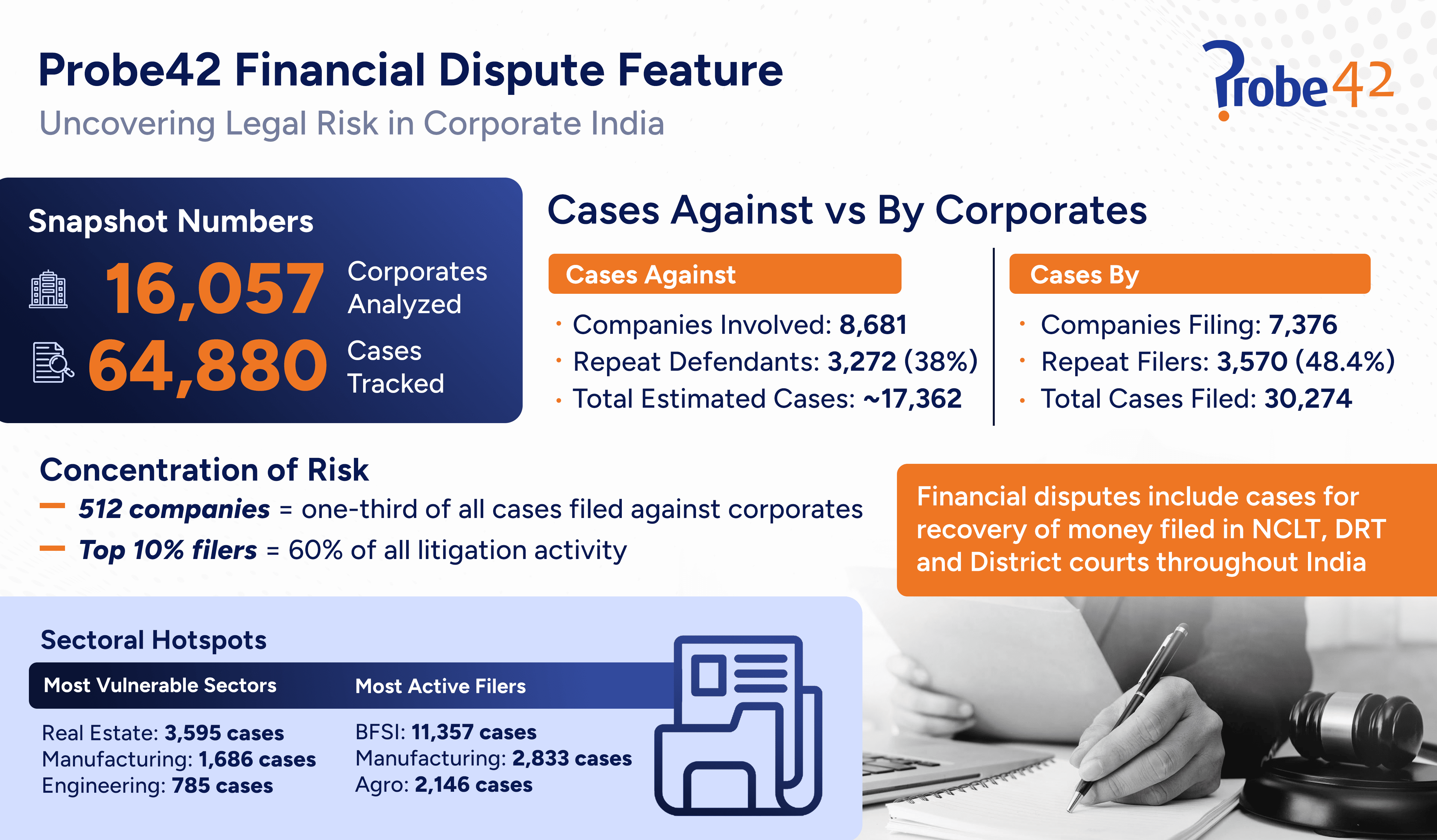
In Brief: Litigation is a critical but often overlooked dimension of corporate risk. Probe42’s Financial Dispute feature tracks over 64,880 litigation cases across 16,057 corporates, giving lenders, investors, and compliance teams a clear view of legal exposure. Key findings reveal that manufacturing, real estate, and engineering face the highest litigation risk, while BFSI and agro sectors are among the most proactive in pursuing recoveries. A concentrated group of companies drives the bulk of litigation, making sector and entity-level monitoring essential for risk assessment.
Financial statements and credit reports provide only part of a company’s health picture. Litigation, especially financial disputes, is a powerful indicator of risk exposure, financial discipline, and potential defaults. Financial disputes include cases for recovery of money filed in NCLT, DRT and District courts throughout India. In fact, financial dispute data also captures a comprehensive collection of insolvency cases and their recoveries, with around 14,841 insolvency cases and 5,406 DRT cases recorded.
Probe42’s Financial Dispute feature aggregates litigation data from over 700 courts and tribunals across India, offering businesses a real-time, structured way to assess the legal risk landscape of corporates. This is especially relevant for lenders, investors, compliance professionals, and business development teams who must evaluate counterparties beyond surface-level financials.
Key Litigation Insights from Probe42 Data
1. Corporates Face Litigation Both Ways
Probe42 data shows:
- 8,681 companies are currently defendants, with 17,362 cases filed against them.
- 7,376 companies are plaintiffs, having filed 30,274 cases.
This dual view matters. While most analysis focuses on companies being sued, firms that regularly initiate litigation can also signal aggressive recovery strategies or frequent disputes with clients and partners.
2. Repeat Litigants Drive Volume
- 3,272 companies (38%) are repeat defendants.
- 3,570 companies (48.4%) are repeat filers.
Repeat litigants create a disproportionate share of legal volume. Once a company enters the litigation cycle, the probability of recurring disputes is high, making continuous monitoring essential.
3. Litigation is Highly Concentrated
- Just 512 companies account for one-third of all cases filed against corporations.
- Among filers, the top 10% (839 companies) are responsible for 60% of all litigation initiated.
This concentration means risk is not evenly spread. Due diligence must flag these heavy litigators early, as they can distort sector-level risk profiles.
Sectoral Trends in Financial Disputes
1. Sectors Vulnerable to Litigation
Probe42 highlights Real Estate, Manufacturing, and Engineering as the most exposed to recovery disputes.
- Real Estate: 3,595 cases
- Manufacturing: 1,686 cases
- Engineering: 785 cases
Together, these three sectors represent nearly one-third of all recovery litigation, pointing to systemic financial strain and weak receivable management.
2. Sectors Proactively Pursuing Recovery
Litigation is not only about defence—some industries actively pursue recoveries. Probe42 shows:
- BFSI: 11,357 cases filed
- Manufacturing: 2,833 cases filed
- Agro: 2,146 cases filed
With 16,336 cases filed collectively, these sectors are not only vulnerable but also more legally assertive, equipped with structured mechanisms to enforce financial claims.
Why This Matters for Risk and Compliance Teams
1. Early Indicators of Stress:
Litigation data often surfaces before defaults appear in financial records, making it a valuable early warning signal. Companies caught in repeated disputes are often struggling with liquidity or governance, and risk teams that track these signals can reduce exposure before defaults escalate.
2. Beyond Balance Sheets:
Financial reports do not always capture payment delays, cash flow strain, or operational disputes. Litigation cases, however, highlight these challenges in real time. This makes dispute data a powerful complement to traditional financial checks.
3. Sector-Wide Systemic Risk:
Certain industries, like real estate and BFSI, dominate dispute volumes. Monitoring litigation trends in these sectors helps institutions anticipate systemic risks and rebalance exposure before stress spreads across portfolios.
4. Identifying High-Risk Entities:
A concentrated group of companies accounts for most litigation cases. These “repeat litigants” are especially risky, as they reflect persistent structural or behavioural issues. Identifying them during due diligence is key to avoiding long-term exposure.
5. Stronger Due Diligence & Compliance:
For compliance officers, litigation insights strengthen KYB, AML, and onboarding processes. With structured data, institutions can make decisions that are defensible, audit-ready, and better aligned with regulatory expectations.
How Litigation Intelligence Transforms Business Decisions
Litigation insights are not only valuable for compliance teams but also have broader applications across business functions. Embedding this intelligence into decision-making provides organisations with a strategic edge.
1. Credit Risk Assessment:
For lenders, incorporating litigation data improves borrower evaluation. Borrowers with multiple disputes are far more likely to default, even if their financials look stable on paper.
2. Investor Due Diligence:
Investors gain a clearer picture of governance and hidden liabilities by assessing dispute history. This helps avoid surprises that could erode investment value later.
3. Vendor and Partner Evaluation:
Corporations can avoid operational risks by screening vendors and partners for recurring disputes. This ensures stronger supply chains and fewer contract disputes.
4. Customer Onboarding and Retention:
FinTech, banks, and aggregators can filter out high-risk customers at the onboarding stage. Continuous monitoring ensures that emerging risks are detected early, protecting business continuity.
5. Strategic Benchmarking:
Sector-level litigation benchmarking helps companies compare themselves against peers. This creates both a competitive lens and a systemic risk map for a better strategy.
How Probe42 Strengthens Legal Risk Monitoring
1. Comprehensive Coverage: Probe42 aggregates litigation data from 700+ courts and tribunals, ensuring no major disputes are overlooked.
2. Real-Time Insights: Stay updated on both new and ongoing disputes, enabling proactive interventions before risks escalate.
3. Entity-Level Profiles: View dispute histories linked to specific companies and directors for granular visibility into exposure.
4. Sector-Level Benchmarking: Compare litigation intensity across industries to identify vulnerable sectors and benchmark peers.
5. Audit-Ready Data: Probe42 provides structured, standardised data, making it reliable for compliance, due diligence, and reporting requirements.
Embedding Legal Risk into Smarter Corporate Strategy
Litigation is no longer just a background check exercise; it is a leading indicator of financial stress, governance issues, and potential defaults. By embedding litigation intelligence into credit, compliance, and strategic decisions, businesses can protect themselves from exposure and gain a competitive advantage.
With Probe42’s Financial Dispute feature, organisations can monitor disputes in real time, detect systemic risks, and strengthen their decision-making frameworks. For lenders, investors, and corporates, this is not only about risk avoidance, it is about building resilient, data-driven growth strategies.
Frequently Asked Questions (FAQs)
1. What does financial dispute data reveal about companies in India?
Financial dispute data shows how often a company is involved in litigation, either as a defendant or plaintiff. It highlights delayed payments, contract breaches, and governance challenges that may not appear in financial statements. Tracking this data gives lenders and investors early warning of financial stress and risk.
2. Which industries in India are most exposed to litigation risk?
Probe42 data shows real estate, manufacturing, and engineering face the highest disputes, mostly linked to receivables and defaults. Meanwhile, the BFSI and agro sectors are more active in filing recovery cases. These trends reveal where systemic risks lie and which sectors use legal routes most aggressively.
3. How can businesses use litigation intelligence in decision-making?
Litigation intelligence helps risk teams, investors, and corporates spot high-risk entities early. It strengthens due diligence, prevents the onboarding of unreliable vendors or customers, and supports better credit and investment calls. Tools like Probe42 also enable real-time monitoring, so risks are flagged before they escalate.
